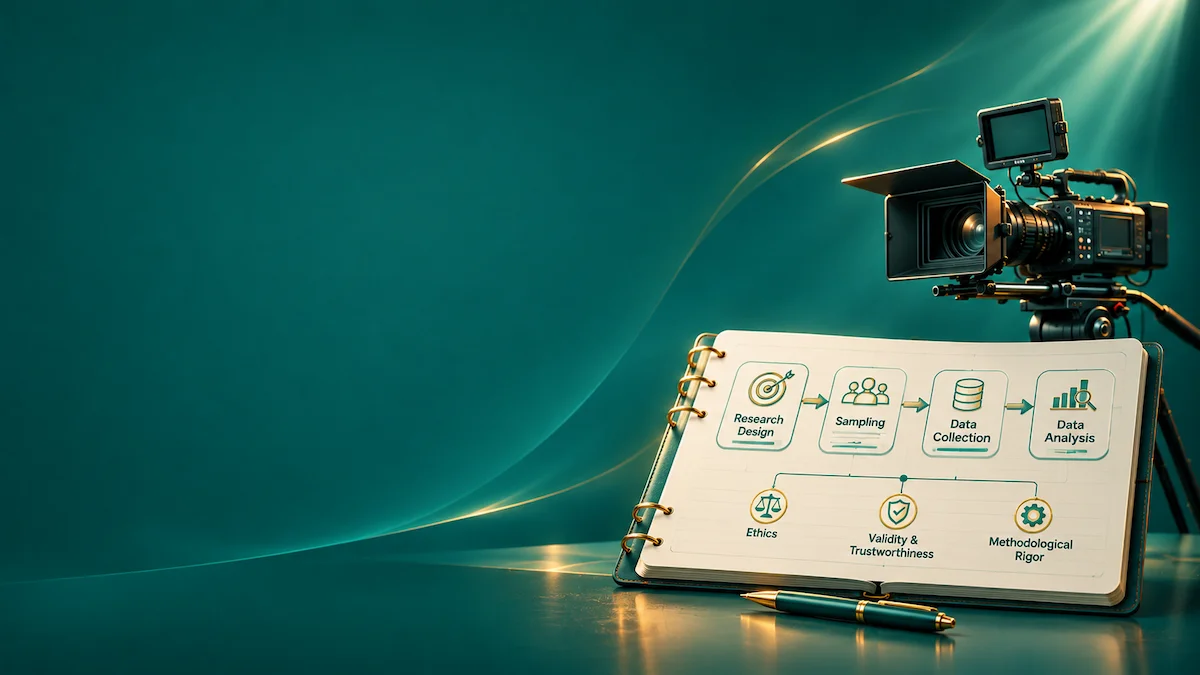
A professional cinema camera on a rig beside an open notebook showing a research flowchart: research design, sampling, data collection and data analysis, linked below to ethics, validity and trustworthiness, and methodological rigour.
An interactive research-support tool for Film and Television Studies

Research Methodology Formulation and Refinement

A guided ten-step path from your research problem and questions to a coherent, justified and feasible methodology — approach, paradigm, design, sampling, data collection, analysis, ethics and quality — with transparent rule-based feedback, an editable methodology draft and a final report.

Academic Tool Developed by Dr. Merfat Alardawi
Core tool

Research Methodology Builder

Work through the ten steps. Each step explains what is needed, gives an example from film or television research, and checks your entries for consistency. Your progress is saved on this device only.

Tool A

Methodology Selection Guide

Methodological terms are often used as if they were interchangeable. They are not: a paradigm, an approach, a design, a data collection method and an analytical technique answer different questions about your study.

Five levels of methodological decision

Comparing the three approaches

Which approach suits your study?

Bilingual Methodological Terminology Guide

Research Design Explorer

Research designs for film and television research

Each design is a logic for the whole study, with typical data, a discipline-specific example and a caution. Mixed-methods designs are distinguished by when the strands are collected and how they are integrated (Creswell & Plano Clark, 2018).

Sampling and Data Collection

Choosing participants, cases and texts — and how to gather data

In film and television research, the sample may be people, audiovisual texts, online content or documents. Each needs explicit selection criteria and an argument for adequacy rather than a fixed number.

Sampling and selection strategies

Judging sample adequacy

Data collection methods

Data Analysis Guide

Analytical approaches and the dimensions of audiovisual analysis

Choose analysis that fits both your question and your data. The labels under each approach show the kinds of data it is usually applied to.

Dimensions of audiovisual analysis

Tools B and C

Methodology Evaluation

The Research Methodology Quality Checker and the Research Alignment Matrix read your Builder entries and update as you work. The five-point rubric and the final report are in Step 10 of the Builder.

Research Methodology Quality Checker

The checks below read your Builder entries. They test consistency, not quality of thought.

Questions to ask yourself

    Research Alignment Matrix

    How the problem, questions, objectives, theory, design, data collection and analysis connect. Filled cells are marked ●; links are checked by simple rules.

    Tool D

    Academic Examples Library

    Two clearly separated kinds of example: hypothetical teaching examples written for this tool, and published studies whose methods are summarised from the articles themselves (see References).

    Hypothetical teaching examples

    Published studies

    Academic References

    References (APA 7th edition)

    The attached reference file — methodology tutorials and film, television and audiovisual research articles — is the foundation of this tool. It is supplemented with established methodological literature and recent studies on sampling, analysis, quality and reporting. Items marked “Details to be completed” still need full publication details.

    Journal quartile rankings (Q1/Q2) and indexing are not stated here because SJR and JCR classifications change every year; check a journal’s current status at scimagojr.com or in Journal Citation Reports. No Arabic-language methodological source could be verified to the standard of the other references, so none is listed; the Arabic terminology follows common usage in Arabic research methods teaching. The tutorial videos in the attached file are practical guidance, not peer-reviewed research.

    About the Tool

    About this tool

    Purpose

    This platform helps researchers and postgraduate students in the Cinema and Television track of the Department of Audio-Visual Production to select, justify, develop, evaluate and refine a research methodology, with priority given to qualitative and mixed-methods research.

    How it works

    All suggestions, consistency checks, draft text and suggested scores come from transparent, rule-based JavaScript — word lists, option metadata and editable templates that can be read in the source files. The tool does not use artificial intelligence, does not verify references and does not judge the validity of a methodology.

    Privacy

    Your answers are saved in this browser’s local storage only, so that you can return to them later. Nothing is sent to a server. You can export, import or delete your data at any time.

    Academic disclaimer. This platform provides research-methodology guidance and educational support. It does not replace scholarly judgement, academic supervision, expert methodological review or formal ethics approval. Self-assessment scores are tools for reflection, not validated measures of quality. All cited publications, reference documents and images remain the intellectual property of their authors and rights holders.